12TH 14TH OCTOBER 2010 MAPUTO, MOZAMBIQUE.
At the COFI meeting in 2009, it was decided that there should be an international instrument for securing rights of the Small Scale Fisher People. This was a follow up work of the whole process initiated at Bangkok in 2008 at the 4SSF conference.
The respective officials decided at the COFI meeting to draft an instrument for securing small scale fishers while organizing 3 regional workshops in Asia[Bangkok, Thailand], Africa[Maputu, Mosambique]and Latin America [Caribbean islands] prior to COFI meeting in Janusry, 2011.
Andrew Johnston of Artisanal Fishers Assosciation at South Africa is one of a participant to African work shop at Maputu, Mosambique representing WFFP.
Following is his observations and would reflect his views of the same WS.
Herman Kumara
Sixty participants from the Africa continent which included government fisheries ministry, civil society and Food and Agriculture Organization of the United Nations participated in this regional workshop in Maputo. The expected outcome was that there had to be guidance on a possible international instrument to plan, implement and report on securing sustainability and Ecosystem Approach to Fisheries in Small-Scale Fisheries within the Africa context. Secondly high priority actions and potential gaps in the implementation of good governance practices in SSF and related assistance needs. The decisions decided at this workshop would be presented to the 29th session of the FAO Committee on Fisheries in January 2011 Rome. Presentations were given on Governance, reducing vulnerability to natural disasters and climate change, gender, Human Rights based development framework and existing international instruments related to SSF in Africa. Given the dilemma of the majority of civil society invitees being stuck at O.R.Tambo International Airport due to Visa snags and a few only filtering into the workshop late on the second day the conclusion was very positive and enlightening. With government officials, civil society and policy-makers seating in close proximity in a small conference room, my expectation was one of “they disregard the lives of the downtrodden that they little understand” and nothing will be achieved but I was pleasantly surprisingly proved wrong in my assumptions. The workshop synthesis report from the working group’s discussion was the feeling that here from Africa were some genuine people who wanted to build equitable societies, achieve justice for all and not crucify our hope of a fairer Africa.
We therefore could walk away from this workshop extremely delighted on the outcome that the basis was comparable to the Bangkok resolutions and as a South African it was marvelous that our new small-scale policy actually was completely in line with the proposals. {See attachment of proceedings] The issue of co-management, ecosystem approach, communal rights, and fisher’s right to development, rights based approach and the rejection of privatization all being music to our ears. The sticky issues was the problem of migrant fishers which was not resolved mainly it was contrary to some countries national policy also because of only having a few civil society members present we did not give a full presentation from our group. This presentation will have to be forwarded by WFFF and WFFP to the secretariat along with additional proposals on human rights of small-scale fishing of which there was considerable debate. The feeling amongst us was that the issue of human rights was to an important issue to finalize although those already decided was acceptable, {still awaiting this from FAO] there was extra rights that should be work shopped amongst our members as the thinking on human rights differ in various cultures around the world. Whether the final findings from the regional workshops should be incorporated into the Code of Conduct for Responsible Fisheries or be similar to guidelines as in the Right to Adequate Food was discussed at length and the general consensus it should be guidelines. All in All given the very bad organizational arrangements by the organizers of civil society it was a wonderful experience and a huge success as networking exercise and a boost towards our struggle for rights.
Thanking You,
Andrew Johnston,
World Forum of Fisher Peoples'[WFFP]
Wednesday, October 20, 2010

Monday, August 30, 2010
Agreement Between Indian & SL Fishermen on Fishing at Palk Bay

Text of Agreement between Indian and Sri Lankan fishermen representatives who met at St.Thomas Mount, Chennai, India, from 20th to 22nd August 2010.
English Translation (Original in Tamil)
The following proposals are made by the Sri Lankan team after the discussions it had with Indian fishermen (since its arrival in India) from 16th to 22nd August on the issues of fishing on the Indo-Sri Lankan border and after taking into consideration the various proposals made by Tamil Nadu (fishermen).
1. On basis of the firm assurance that Indian fishermen will stop mechanised trawl fishing in Sri Lankan waters within a period of one year, the following proposals have been made.
2. Boundaries have been fixed for (trawl) fishing beyond the Sri Lankan-Indian border in Sri Lankan waters in a manner that the livelihood of Sri Lankan fishermen will not be affected.
This will be as follows;
A. In the Palk Bay, north of the Mannar Island, fishing can be done beyond a distance of 3 nautical miles from the Sri Lankan shore.(Fishing should be done seawards of Palathivu and Iranithivu).
3. Fishing will be done (in the Palk Bay) on the following days in different months,
Month Monday Tuesday Wednesday Thursday Friday Saturday Sunday
January 4 4
February 4 4
March 4 4
April 2 2
May
June 4 4
July 4 4
August 4 4
September
October 4 4
November 3 3
December 2 2
Total number of days allowed for fishing: 70 days
Timings: Afternoon 4 pm to morning 4 am
Days of fishing: Wednesday and Saturday
B. In the Palk Straits of the northern Jaffna coast, fishing can be done up to 5 nautical miles south of the Sri Lanka-India maritime border. (This will be applicable for the area starting from the west of Delft Island till East Wadamarachi border)
C. In the Gulf of Mannar, south of the Mannar Island, fishing can be done till a distance of 5 nautical miles from the Sri Lanka-India border
4. Use of pair trawls is to be completely avoided. Care has to be taken not to affect small scale fishing operations. Number of boats (coming from India) need to be fixed.
5. These proposals will be placed before the two Governments for their consideration. Government decision will be final.
6. All the conditions for fishing (by Indian trawlers) should be monitored with the help of the two Governments.
7. The monitoring group should be composed of representatives from the fisheries officials, fishermen and the Navy/Coast Guard from both countries.
8. For taking action on violations to the conditions imposed (on fishing by Indian trawlers), committees shall be formed on both sides to take suitable corrective action. In the case of disputes in the implementation of this agreement between the two sides, ARIF in India and NAFSO in Sri Lanka will be responsible to mediate and sort out the issues.
9. All difficulties arising in implementing these proposals and new issues will be discussed in the next round of talks between the two sides in Sri Lanka.
10. With regards to fishing by country boats, the use of mono-filament nets needs to be avoided and this will be discussed in the next round of talks.
11. These proposals will apply to all Tamil Nadu mechanised boat fishermen (who operate in the areas mentioned in this agreement).
The above proposals have been accepted by fishermen representatives of both countries and their signature affixed hereunder.
Sunday, August 8, 2010
The Praja Abhilasha People's Tribunals are in Progress
The 7th People's Tribunal held at Trincomalee yesterday at Trincomalee with wider people's participation. There were number of issues emerged related to Tsunami, War, Land Tenure and Human Elephant Co-existence in relation to Praja Abhilasha Land coalition.
Now, the PPT work is coming towards the end and the land movement building activities are the most pressing need to address those issues emerged.
As Raajan Francis, the coordinator of PA says, "We will go forward with more organized manner in 6 major issues emerged at the PPT. We are already on move with the H/E coexistence issues in Kurunegala and Moneragala districts".
"War and Tsunami affected people are one of the most affected ones and we need to address their issues. However, the present undemocratic system made the affected people in a numbing and vulnerable. Need strong people's engagement to break this apathy" Says Dr.Ravi Varma, one of a Judges in the PPT.
As, NAFSO team we are engage in many ways to make this effort a success as the facilitating and coordination centre of Land Coalition of Praja Abilasha.
Herman Kumara
Now, the PPT work is coming towards the end and the land movement building activities are the most pressing need to address those issues emerged.
As Raajan Francis, the coordinator of PA says, "We will go forward with more organized manner in 6 major issues emerged at the PPT. We are already on move with the H/E coexistence issues in Kurunegala and Moneragala districts".
"War and Tsunami affected people are one of the most affected ones and we need to address their issues. However, the present undemocratic system made the affected people in a numbing and vulnerable. Need strong people's engagement to break this apathy" Says Dr.Ravi Varma, one of a Judges in the PPT.
As, NAFSO team we are engage in many ways to make this effort a success as the facilitating and coordination centre of Land Coalition of Praja Abilasha.
Herman Kumara
Friday, June 25, 2010
Research Report for the Sustainability & Management of Inland Water Bodies in Sri Lanka


The report prepared for the purpose of the management and sustainability of the inland fishers with the research conducted at 14 sites in 7 districts among the coastal and inland fishing communities was launched at the SLAAS auditorium on 22nd June in connection with the Small Scale Fisheries Convention organized by National Fisheries Solidarity Movement[NAFSO].
Mr.Nalaka Rozairo, the coordinator of Policy Studies of NAFSO presented to research findings at the convention which are alarming for actions and need highest and immediate attention of policy makers as he shared.
The most importantly,
> analysis of the technology,
> management practices,
> institutional structures,
> leadership of the communities,
> environmental aspects,
were covered at the research which are very important on policy making process of the authorities on management practices in inland water bodies.
This report would be circulated among fishing communities, fisheries officials, National Aquaculture Development Authority[NAQDA] and officials at MOF in the Central Government as well as Provincial COuncils in the country for their attention, study and action.
Herman Kumara
26.06.10
Wednesday, June 23, 2010
"Let's Build Up an International Instrument to Sustain Small Scale Fishers and the Industry"


“We are small Scale fishers’ representatives. We feed the nations with much stress and difficulties among us. But, we can solve the issues of the food security, energy crisis as well as the global warming in the globe today. So, we are not the part of the problem of major crisis in the globe today. As you all see, we are part of the solution". While welcoming the gathering at the small scale Fishers National Convention, Ms. Geetha Lakmini, the Secretary of the National Fisheries Solidarity Movement shared her views.
There were around 200 small scale fishers, scholars, researchers, university teachers attended the small scale fishers convention representing from 14 districts in the island. Most of them were hopeful to share their views with the minister of fisheries and were frustrated with the absence of him and his officials. So, the people were shared their frustration and the anger against them.
Mr.Ansel Fernando, a small scale fisherman of Wathuregama, Balapitiya, very strongly condemned the absence of the minister.
“The ministers and the politicians do not have any solutions for our issues. That is why they do not come to meet us. Why we invited them? We wanted to tell what we expect to build up this industry. What they can do the help the sustenance of the small scale fishers. They are not concern about us. But, this is the way they want to make the Sri Lanka a wonders in the Asia.”
Ansel shared his anger with firing speech which was received highest attention and appreciation from the audience.
However, what Sarath Fernando said is some thing opposite to the above sharings.
“We need not to bother about the absence of the Minister or the Politicians in our gathering and need not to echo our grievances. We should learn how to work while neglecting them. Although, we think the elected ministers and the regime is there for the people, it is not so. So we need to plan out our proposals and do what ever possible for our own destiny.” Sarath Fernando, a veteran social activist, coordinator of MONLAR narrated at the open discussion held at the National Convention on Small Scale Fisheries, under the theme of
“Let us build up an International Instrument for sustainability of Small Scale Fishing industry and the fishing communities.” Which was held at SLAAS at Colombo.
The Committee on Fisheries [COFI] of Food & Agriculture Organization the Rome based agency of the United Nation, has decided to formulate an international instrument for the small scale fisheries and will be organized 3 regional conferences aiming at to discuss the out comes at the COFI 2011. The World Forum of Fisher Peoples’ [WFFP] has seen the importance of having national consultations prior to the regional conferences in order to discuss the national issues in depth at the respective countries.
So, National Fisheries Solidarity Movement , a WFFP member organization in Sri Lanka, had organized series of consultations at the community level to district levels prior to the such national consultation.
“ We planned to get wider participation of small scale fishers through the series of workshops from village level up to national level in this process. As a result we were able to organized 3 major workshops among the fisher women, inland fisher people as well as with small scale coastal fishers and the fish workers in the multiday fishing boats. With this work we were tried to open the debate on sustenance of small scale fishers as they are supposed to be extinct in the near future. Do we allow this to happen or do we commit to change this situation? It is in our hand as small scale fishers. ”
Herman Kumara, the national convener of National Fisheries Solidarity Movement challenged the gathering at the presentation of the objectives session.
“We do not allow to loose our fishing grounds with selling the coasts to tourism or aquaculture investors. We want to emphasize our customary rights. If any one want to protect small scale fishers, they should protect the fishing environment, sustenance of fish stocks, post harvest products of our fisher communities. We expected to submit our issues as well as the possible solutions to the authorities. They are not present here today. Then who are the responsible people to tell our issues.?” says Loyel Peiris, a small scale catamaran fisherman, and a fisher leader from Barudalpola, Thoduwawa in the North Western Coast of the island.
The organizers were attempted their best to get the fisheries authorities to the occasion and some of them promised to do so. However, with their reasons none of them participated and not informed too.
So the fisher groups were not discouraged and decided to go to the fisheries ministry and meet the fisheries minister and the officials. All the people in the gathering agreed to go to the fisheries ministry and submit the proposals they prepared.
At the sharing of inland fisheries, issues of fisher women and the issues of northern and eastern provinces, all the people expected strong intervention by the government while getting the support of the fisher communities.
A.J.Anderson, small scale fisherman of Parakrama Samudraya at Polonnaruwa, shared the necessity to reorganize the fisheries cooperatives as one of the main tool to fisheries management purposes as well as sustenance the livelihoods for inland fishing communities.
“Small Scale Fishers need freedom from the Investors. Most of them are under the custody of the Mudalalis and the fishermen do not get any reasonable share from them. Most of the time the families are suffering as they can not survive with the small amount of earning of the bread winner.” That was the voice of A.I.M. Zackiras of District Fisheries Organization at Pothuwil, Ampara district.
“Indian fishing fleets are destroying our waters seriously. They are dangerous too. Three days of the week we do not go to the sea due to fear. Mannar and Jaffna district fishers who were affected very badly by 30 years long war are affected again with this situation. They engage in bottom trawling which is very harmful to the fishing industry. This situation should change to sustain the fisheries in the country. At the same time, most of the fishers were displaced due to war. Some are still in the camps. Others did not receive proper treatments for so called resettlement process.” Vincent Lambert, a fisherman of Arripputhurai fishing village at Mannar, a war tone area in the north shared his views at the national convention and proposed possible direction to build up the small scale fishers in the north and the east.
As decided by the group at the gathering with consensus, every one participated at the convention went to the Ministry of Fisheries and decided who will be the persons participate the meeting with the minister and his officials. There were 15 people volunteered to meet the Minister though the group got only the promise to have another appointment with the minister due to the unavailability of the minister and the officials at the time the group reached the ministry.
Monday, June 21, 2010
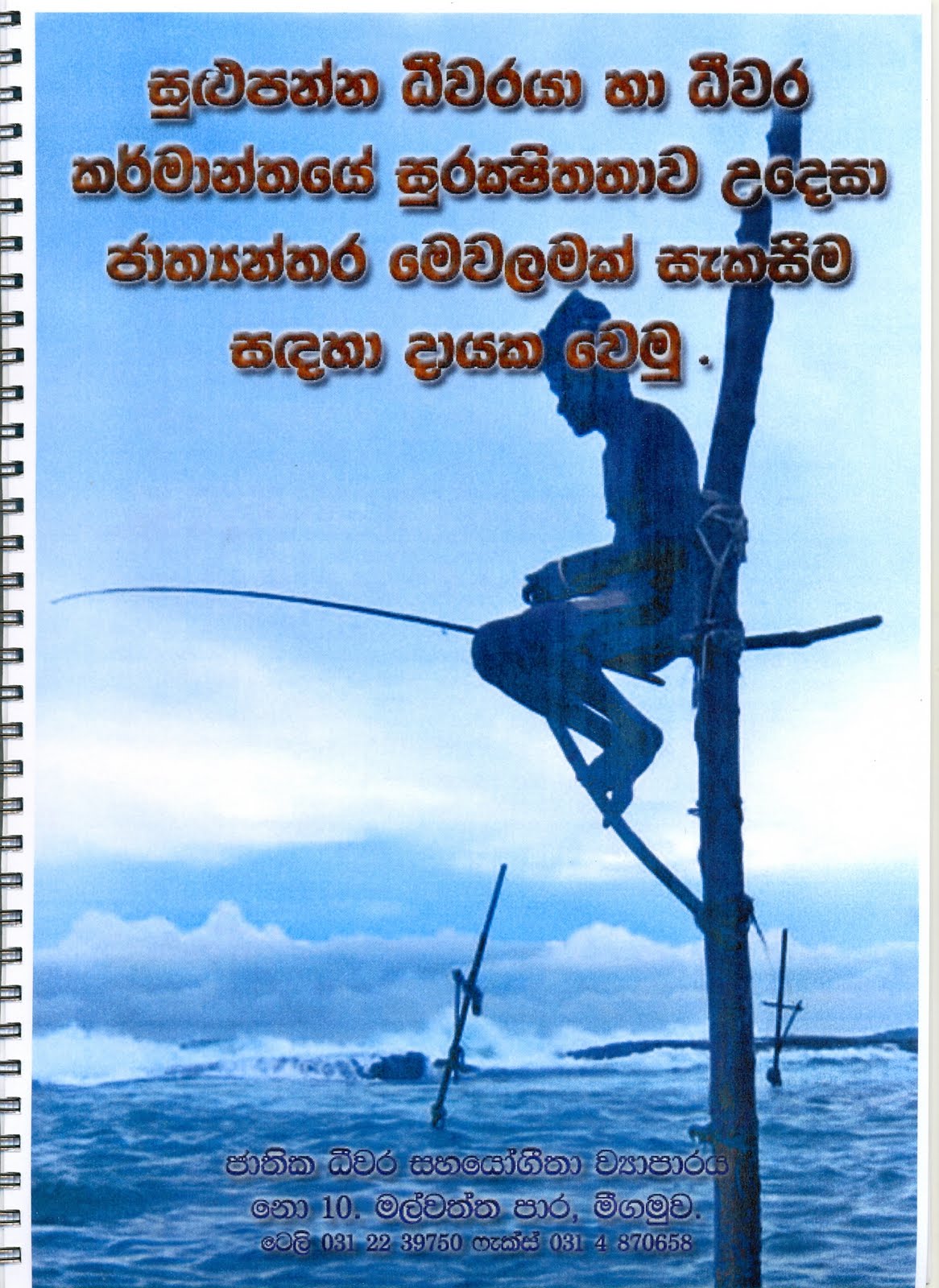
“Let’s build up international instrument to secure the sustainability of fisheries industry and small scale fishers”
Join with us for securing the sustainability of small scale fishers & the fisheries industry
(The national conference is to be scheduled to hold with the above objective nationality, regionally & world wide)
2010.06.22 - National Conference
“Vidyabhiwardana Conference Hall
No. 120/16 , Wijerama Road
Colombo 07”
10.30 AM - 2.30 PM
We cordially invite you to attend this conference representing from, ministry of fisheries and Aquatic Resources, Word Food and agricultural (FAO). Non governmental organization as well as fisher communities
Adjenda
2010.06.22
Suggested facts from conducted women’s conference.
Presenting the suggested annual report to securing small scale fishermen’s industry.
Presenting island fisheries research report.
Presenting specific suggestions on island fishery.
Suggested process to secure the sustainability of fisheries industry small scale fishermen, Presenting the Contribution, Government, NGO, and FAO.
Join with us for securing the sustainability of small scale fishers & the fisheries industry
(The national conference is to be scheduled to hold with the above objective nationality, regionally & world wide)
2010.06.22 - National Conference
“Vidyabhiwardana Conference Hall
No. 120/16 , Wijerama Road
Colombo 07”
10.30 AM - 2.30 PM
We cordially invite you to attend this conference representing from, ministry of fisheries and Aquatic Resources, Word Food and agricultural (FAO). Non governmental organization as well as fisher communities
Adjenda
2010.06.22
Suggested facts from conducted women’s conference.
Presenting the suggested annual report to securing small scale fishermen’s industry.
Presenting island fisheries research report.
Presenting specific suggestions on island fishery.
Suggested process to secure the sustainability of fisheries industry small scale fishermen, Presenting the Contribution, Government, NGO, and FAO.
Subscribe to:
Posts (Atom)
